How I Survived Without a 'Mute' Button
The 3D Educator

For the last decade, I have existed primarily as a 1080p rectangle.
My professional identity was forged in the fires of fibre-optic cables and stabilised by a ring light that made me look significantly more alive than I usually felt at 8:00 AM.
I was a digital nomad who never actually moved - a freelance educator whose world had shrunk to the precise dimensions of a 27-inch monitor.
Ten years is a long time to spend as a ghost in the machine.
In that decade, empires have fallen, social media platforms have mutated into unrecognisable hellscapes, and I have entirely forgotten what it’s like to have a student see my shoes.
To be an online educator is to live in a curated, controlled environment.
If a dog barks, I have a mute button.
If I’m bored, I can discreetly check my email in another tab.
If a lesson goes south, I can blame an “unstable connection” and disappear into the ether.
So, when the opportunity arose to step back into a physical classroom, my first instinct wasn’t professional excitement. It was pure, unadulterated terror.
The digital cocoon I had spun around myself felt safe, but it was also starting to feel like a cage.
The thought of standing in a room with a real, breathing human - one who couldn’t be minimised or shut down with a click - was a worrisome prospect.
I had become a master of the interface, but I had lost my grip on the interaction.
The “No-Tech” Ultimatum
Deciding to return to face-to-face teaching was one thing. So, perhaps then doing it without a laptop was professional masochism.
Online, I am a god of the taskbar - twenty tabs open, three AI assistants on standby, and perfectly formatted PDFs.
Offline? I felt like I was trying to perform surgery with a spoon.
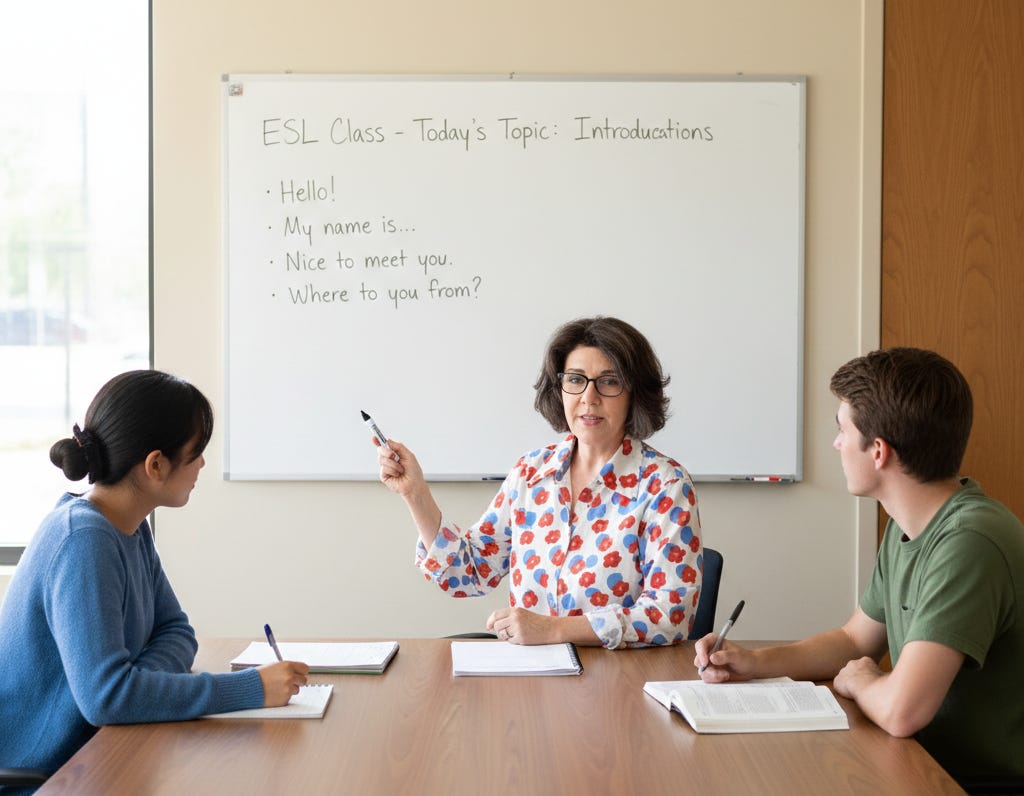
I walked in with only my brain and a whiteboard marker.
There was no “Share Screen” to hide behind.
No way to fake a frozen camera if I forgot a word.
Just me, raw and exposed.
The phantom limb syndrome was real. Every thirty seconds, my hand twitched for a mouse that didn’t exist.
I stared at the whiteboard - a terrifying, non-backlit slab of plastic - realising there is no “Ctrl+Z” in the physical world. If I made a mistake, I had to physically scrub away the evidence with a felt eraser while my students watched in high-definition silence.
It was an analogue ultimatum: rely on actual teaching instincts, or let the room swallow me whole.
The Sensory Overload: High-Definition Reality
Stepping into the room was like switching from a 1990s GameBoy to an IMAX theatre.
For years, my “classroom” had been a flat, rectangular portal where the only smell was the ozone of my laptop fan and the only sound was the compressed chirp of a student’s microphone.
Suddenly, I was hit by the olfactory reality of a physical space: the sharp, vinegary tang of the dry-erase board, the faint aroma of stale breakroom coffee, and - shockingly - the scent of actual humans. I even had to remember not to eat too much garlic for a couple of days before the class! Really!
Everything was inconveniently three-dimensional.
In the digital world, eye contact is an illusion - you stare at a glass lens while your student stares at a different glass lens.
In a room, eye contact is a live-wire connection. I found myself startled by the sheer physics of it all. The way sound bounced off the corners of the room instead of being processed through a noise-cancelling algorithm.
Perhaps most striking was the silence.
In a virtual call, silence is a technical failure; it’s the sound of a dropped connection or a frozen screen.
In the classroom, silence has weight.
It is the sound of thinking.
It was a terrifying, heavy quiet that I couldn’t “fix” with a Spotify playlist or a quick “Can everyone hear me?”
It forced me to actually sit with my students in the space we were sharing.
The Pedagogical High: Why it Felt Better
Despite the phantom mouse-clicks, something strange happened halfway through the lesson: I started having fun. Real, tangible, non-pixelated fun.
In the online world, “engagement” is a metric.
In a physical room, it is a temperature.
I could feel the heat of a good idea catching fire.
When I made a joke, the laughter hit me like a physical wave.
When a student finally “got” it, I didn’t have to wait for them to type “Ohhh” in a chat box. I saw their eyes widen.
After ten years of digital buffering, it felt like I was seeing in colour for the first time.
I also rediscovered the lost art of the “pedagogical walk.”
I realised that physical proximity is its own instructional tool; standing next to a student feels like an act of solidarity that a virtual window cannot replicate.
Without a slide deck acting as a rigid itinerary, we were finally free to wander. In that room, the tangents were the lesson. A student’s off-hand curiosity didn’t require me to find a specific link; it just required a quick pivot to the whiteboard.
The lesson wasn’t something I was performing; it was something we were exploring together.
The Business Case for Getting Out
There is a cold, hard business case for leaving your home office.
As freelance educators, we often mistake convenience for efficiency. But after a decade of digital insulation, my “educator instincts” had become blunt.
I was teaching through a filter that distorted my perception of what my clients actually needed.
Stepping back into a classroom is like taking your brain to a professional development gym. You rediscover the nuance of pacing and the weight of a pause - high-level skills that translate back into your online business as a superpower.
But let’s get tactical. F2F teaching is a high-conversion marketing channel.
The Analogue Lead Magnet: A physical business card in a co-working space has a higher “trust-per-pixel” ratio than any Facebook ad.
The “Hallway Effect”: Conversations during coffee breaks led to three corporate referrals in a single week - opportunities that would have been buried in a Spam folder.
Micro-Market Penetration: By partnering with a local hub, I tapped into a demographic that actively avoids “online-only” services.
It prevents the burnout that comes from staring at a glowing rectangle for forty hours a week.
It reminds you that you’re not just a content delivery system; you’re an educator.
The Offline Challenge
If you’ve spent a decade as a 2D rectangle, the physical classroom sounds like a horror movie. I get it.
I was the one who panicked when my Wi-Fi dropped. But I’ve learned a truth that fibre-optics hide: the world isn’t a rectangle.
I’ll be honest, my return was terrifying and awkward.
I definitely forgot how to stand like a human for the first twenty minutes. But it was the most reinvigorating shift since I first hit “Share Screen.”
Ditching the tech wasn’t a gimmick; it was a palate cleanser for a brain saturated in blue light. It reminded me that I am a teacher, not a software operator.
Here is the challenge: find a room.
A workshop, a seminar, or just a coffee with a student.
Step away from the ring light.
Leave the laptop in the bag.
Rediscover teaching with nothing but your voice, your presence, and a smelly marker.
I’m not quitting online - the commute is too good - but I am getting out. There is no digital substitute for the non-buffered magic of human connection.
I’ll see you in the real world.
Takeaway: Your business grows when you do, and sometimes growth requires leaving the digital comfort zone to remember why you started teaching in the first place.
When was the last time you taught without a screen? Tell me your scariest F2F story or your plan to try one this month in the comments below!
My Substacks…
If you are an online freelance educator, follow me at Teach, Train Coach:

If you are an English language learner, follow me at English Language Lab: